

Bryan L. Kirk
May 12, 2026
Meet PayrollOrg President Jim Medlock, CPP
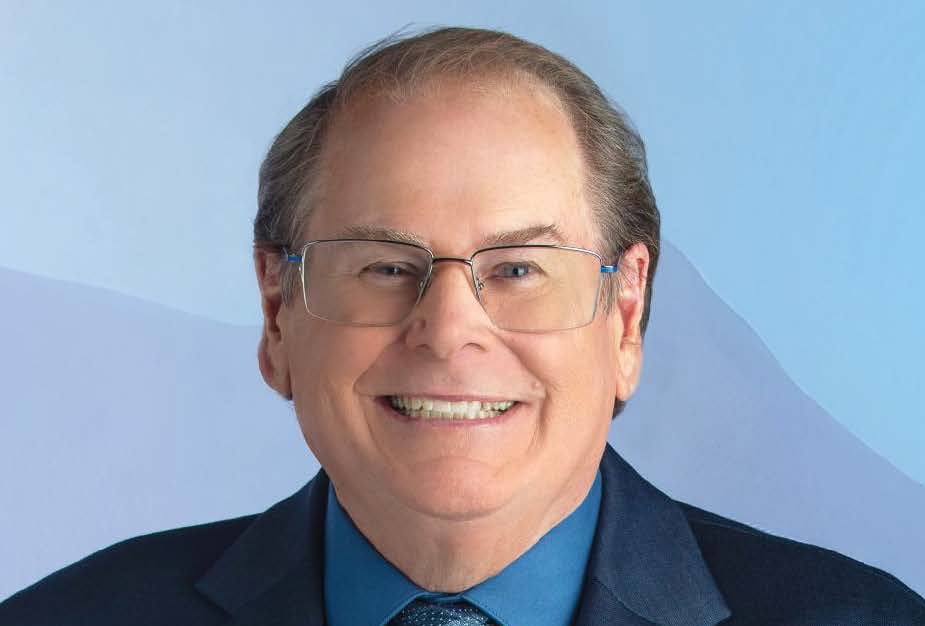
PayrollOrg President Jim Medlock, CPP, shares insights and experiences that made him a payroll industry legend.
BY BRYAN KIRK
There are not too many people today who can say they have worked in a single profession for 50 years or more, and it’s likely that there are even fewer who remain actively involved in their chosen profession even after their retirement.
PayrollOrg President Jim Medlock, CPP, is an industry legend who started his payroll career more than half a century ago. And although Jim officially retired in 2019, he remains actively involved teaching PayrollOrg’s courses to the next generation of payroll professionals.
Early Lessons, Life-Long Impact
The oldest of four children, Jim was born in Kansas City Mo. When Jim and his siblings were still very young, the family moved to Lawrence, Kan., where his father attended the University of Kansas and earned his pharmacy degree.
“When Dad had his pharmacy degree, he purchased a drug store in Bartlesville, Okla., which was where we moved when I was in elementary school,” said Jim.
One of Jim’s earliest lessons happened during a Christmas Day long ago. It was a quiet and peaceful family holiday until his father received an urgent call during Christmas dinner from a local physician who had a patient who needed a prescription filled.
“After we finished Christmas dinner, I went with my Dad to the drug store. He prepared the prescription, and we took it to the home of our customer,” Jim recalled.
The lessons he gained from that experience were many, such as selflessness and looking out for those in need. However, there was another important lesson Jim took from that long ago Christmas Day: customer service matters.
“Always be aware of your customers,” he said.
As Jim entered his junior high school years, he discovered an insatiable love for numbers that would ultimately follow him beyond his academic career.
“I took advanced math in junior high and high school, but when I got to college, calculus stumped me,” he said.
Jim realized that he wanted to devote himself to an academic path, and a career that involved less complex math. He majored in accounting—and ultimately transitioned into payroll—which seemed to fit his career niche.
“I liked the precise nature of accounting and payroll,” Jim said. “Of course, like so many other payroll professionals, I soon fell into payroll.”
That 1970s Payroll Game
It was a time when nearly everyone was disco dancing, a tank of gas cost just 60 cents a gallon, mini and microcomputers were making their mark, and direct deposit was beginning.
It was 1975, and Jim had just earned his master’s degree in accounting from Oklahoma State University. Not long afterward, he landed his first post-graduate job with Denver Water, in Denver, Colo.
“I was a one-person payroll department for Denver Water,” Jim recalled. “I think payroll was the job at Denver Water that nobody wanted.”
Calling 1970s payroll a tedious endeavor would certainly be true by 21st century payroll standards, but Jim treated it like a game and that helped to ensure the paychecks for Denver Water employees were always accurate and on time.
“For most of my first 10 years in payroll, we only paid employees with paper checks that were mechanically signed,” said Jim. “After a while, it sort of became like a game to me, and the object of the game was to have as few errors as possible as well as to get it done as quickly as possible.”
Sometimes those mechanically signed paper checks would become stuck in the machine, and that made the game of payroll even more challenging.
To ensure all the checks were accounted for, the city auditor’s office—where the checks were all printed and mechanically signed—an adding machine tape would be run.
While occasionally there were checks that became stuck, there was an instance that they somehow “missed paying some people,” Jim said.
And it just so happened that some of those people who were missing checks were in the executive office.
“We were able to write manual checks for them,” he recalled.
There were questions from a few who noticed that their paychecks were handwritten, and one of those individuals confronted Jim in the elevator the next day wanting to know why his check was handwritten.
Jim simply smiled at his colleague and said, “Well, we had a problem, but we fixed it.”
Technology and Direct Deposit
While direct deposit was slowly becoming accepted among some organizations, Denver Water still wasn’t one of them.
“I had been trying to implement direct deposit, but our treasury department did not want to lose the interest earned while paper checks were in transit,” Jim said.
Employees would either cash their paychecks at their bank or bring their paychecks to the city and county treasury department that were required to cash employee checks whenever they were presented.
But there was a moment when leadership at Denver Water began to see the benefits of direct deposit, and it all started with a series of unfortunate events involving an open parking spot and an angry judge.
“One payday, we distributed checks at the beginning of the day, and one of our employees, who drove a dump truck, went straight to the city office, parked in an open spot, and had his check cashed,” said Jim. “Later that morning, we heard from our chief executive officer (CEO) that we needed to meet with him to explain why employees needed to cash checks at the city office.”
Jim later learned that the dump truck driver had parked his city-owned dump truck in parking reserved for a judge who happened to be a close friend of the Denver Water CEO. The judge complained to Denver Water’s CEO about the parking issue, which caused the judge to be late for court.
When Jim tried to explain the issue to the CEO, the CEO said the policy would be changing immediately.
“Two months later, direct deposit was implemented, first with 40% of the employees, and soon after, we were up to 90%,” Jim recalled.
Payroll was becoming more streamlined, and while this was the first big payroll advancement in Jim’s career it certainly would not be the last.
Fast forward a half-century, and the world of payroll has seen the explosion of technology that birthed fantastic processes like employee and manager self-service (ESS/MSS), paycards, and earned wage access (EWA).
“It’s been pretty amazing,” he said.
The PayrollOrg Intro
Before Jim became aware of PayrollOrg— then the American Payroll Association (APA)—he believed that payroll was a routine. Sometimes, he felt like he was the only payroll professional in the world.
It was 1983, and he’d been with Denver Water for eight years. Jim would soon realize he was not alone in the world of payroll. One day, Jim received a printed brochure announcing the first-ever APA Payroll Congress.
“No one in the accounting department went to conferences outside Denver, so I didn’t even ask to go,” Jim recalled.
He forgot all about the conference brochure. For the next year, life went on, and so did payroll at Denver Water. Then, in 1984, Jim was contacted by payroll professionals who were forming the Denver Payroll Chapter of the APA.
He jumped at the chance to join and network with other payroll professionals. It was there that Jim became friends with Mary Jo Maley, CPP, who would go on to become the APA president in 1996 and one of Jim’s mentors. That meeting likely changed the course of Jim’s career.
“I heard about the benefits PAYO (then APA) was providing and that the first Certified Payroll Professional (CPP) exam would be offered in early 1985,” Jim said. “I used Commerce Clearing House’s Payroll Management Guide loose-leaf service to study for the exam and took the CPP exam on the first Saturday in February. Six weeks later, my wife called saying a letter had come in the mail. I asked her to open it, and she told me I had passed!”
Jim became continually active in the Denver Chapter, which he worked closely with Mary Jo to develop and build up. In 1989, Jim and Mary Jo were invited to a PayrollOrg training session held in Washington, D.C.
“Mary Jo recommended to [PAYO Executive Director] Dan Maddux that I would be the perfect person to be the first payroll professional on PAYO staff and develop the training center in San Antonio,” Jim said.
A Change of Scenery
In October 1993, Jim resigned from Denver Water after 18 years. In November, he became PayrollOrg’s Director of Education and Training.
“I have only worked for two organizations since I graduated from college,” Jim said. “I was fortunate to work for two organizations that I loved.”
Teaching seemed like a natural fit for Jim, and this new role allowed him to devote himself to his passion for educating the next generation of payroll professionals.
“Teaching is what I enjoy the most,” he said. “Seeing a student understand a concept and know how to apply it is terrific.
“I also enjoy having a former student from a Payroll 101, 201, or Boot Camp class come to me at Payroll Congress and tell me they passed the CPP or FPC exam because of the class I taught. I always tell them, ‘I was just the encourager—you did the hard work to understand the payroll concepts to be able to answer the exam questions correctly.’”
Of course, Jim wasn’t just PayrollOrg’s Director of Education and Training; he was also responsible for processing the payroll for PayrollOrg staff members for most of his 25-year career there.
“I transitioned the payroll processing over to Sally Hilton, CPP, at the beginning of 2018, and she did that until she retired [in 2024],” he said. “The only thing that was different was the volume. Going from over 1,000 employees [at Denver Water] to just under 100 employees [at PAYO] at the time.”
In 2008, Jim and his wife decided they wanted to move back to Colorado. At that time the three Directors of Payroll Training that reported to Jim were working from home in Atlanta, Tulsa and Las Vegas, so he asked for approval to work from home, In July 2009, Jim and his wife moved to Fort Collins, Colo., where he worked remotely until his retirement.
In January 2019, Jim retired from PayrollOrg after receiving the PAYO Team Member Legend Award. After his retirement, Jim began working as a consultant and a payroll educator under the name Medlock and Associates.
Becoming PayrollOrg President
Being retired has not slowed Jim down in the least. In fact, he still teaches PayrollOrg members to this day. Jim was teaching a virtual Foundations of Payroll Analytics course when his phone, which he uses as a clock during classes, buzzed and vibrated on his desk.
“The phone said Dan Maddux was calling,” said Jim. “When the class had its next break, I texted Dan saying I would call him when the class ended.”
Jim was thrilled to hear that Dan thought he would make an outstanding president and urged him to run. He recalled past-president Carol Franket, CPP, PAYO (APA) first member president, telling him he would be the association’s president some day after Jim was named Payroll Man of the Year in 1991.
When Jim learned that he had indeed been chosen as the next PayrollOrg president, he did what everyone else has done who is about to be president: he asked many of the past PayrollOrg presidents a lot of questions.
Linda Obertin, CPP, who served as APA president in 2010, and as the first PayrollOrg president during the rebrand in 2023, has known Jim for nearly 35 years. “I can say with complete confidence that he is exactly the leader our industry association needs,” she said.
“Throughout his career, he has been an unwavering role model and a tireless advocate for payroll professionals. His breadth of knowledge, deep compliance expertise, and reputation as a renowned speaker make him a trusted authority whose insights consistently elevate the profession.”
Jim Bolek, CPP, who was PayrollOrg president from 2024– 2025, has known Jim Medlock for nearly 20 years and considers him an iconic payroll figure. Bolek said he was thrilled when his mentor was named PayrollOrg’s President-Elect and, at the same time, humbled when Jim came to him with questions.
“Payroll has been so engrained in his day-to-day for so long and he has been such an instrumental part of PAYO, I don’t think that I am qualified to offer him any advice,” he said “I am excited to see what his year brings!”
PayrollOrg Immediate Past President Ginnette Clark, CPP, had several conversations with Jim when he became president-elect and believes he is the right person to lead the association during this next chapter.
“He has a natural ability to bring people together, encourage collaboration, and inspire others to contribute their best,” she said. “In addition, his experience, reliability, and genuine passion for serving the community make him exceptionally well-suited to lead PAYO into its next chapter with confidence and purpose. His steady approach and genuine commitment to service will help create a positive and forward-looking environment for the association.”
Jim said he is excited about what the future of payroll holds and is humbled to become PayrollOrg president.
“Meeting new members, encouraging them, and representing PAYO around the world are all areas I look forward to accomplishing,” he said.
Bryan Kirk is the Senior Writer and Editor of Membership Publications at PayrollOrg.